A Quick Guide to Gena Dunaiev, a Kyiv Underground Legend
A poet, a punk, a tragic genius — he never achieved fame during his lifetime, but his memory lives on in music circles to this day.
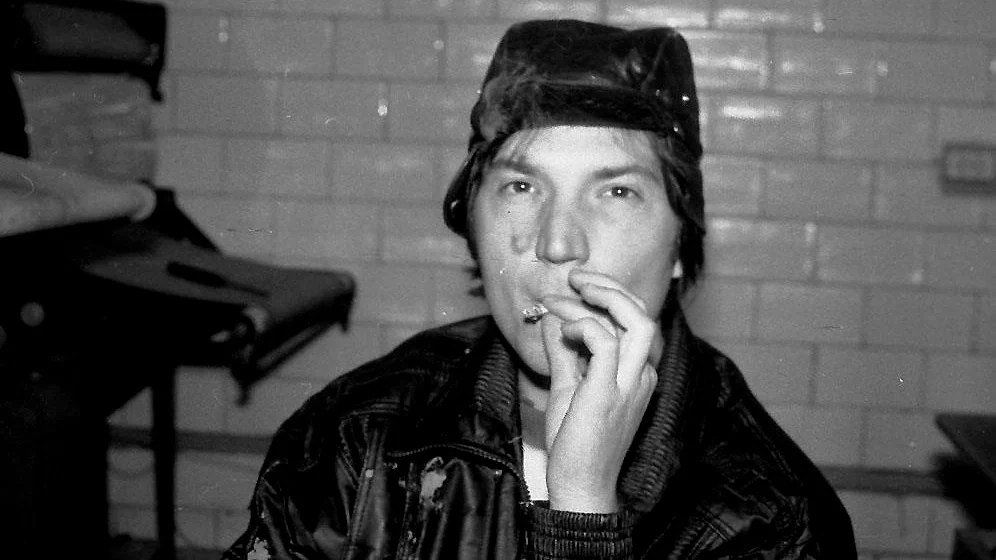
February 14, 1997.
Mykola Ivanovych Levin— a resident of an ordinary two-room apartment in Kyiv’s Lukyanivka neighborhood—found the lifeless body of his 28-year-old grandson in bed. His name was Gennadiy Volodymyrovych Dunaev. It is quite possible that a Kyiv punk also died on that very winter day.
Gena Dunaev, better known as Dunya, believed that he was unlucky in life. Throughout his life, he recorded about 64 cassette albums, played with well-known bands— “VV” and the Russian band “Grazhdanskaya Oborona” (“Civil Defense”) — published underground rock magazines, and served as an actor and director of his own one-man musical theater; yet he never became famous during his lifetime. Instead, he remains forever in the memory of Kyiv’s rock community. Colorful and crazy, sensitive and vulnerable, expressive and depressed—that’s how those who knew him personally describe him.
He was born in the late 1960s in Kyiv. His father— Volodymyr Dunaev, once a well-known guitarist who played in various ensembles and orchestras— left the family early on, and Gena spent most of his life with his grandparents. Gena attended Secondary School No. 61, where he met his friend Igor Pachev; together, they recorded their first experimental tracks in 1985.
That same year, 1985, he was hospitalized for the first time. For the rest of his life, he would suffer from bipolar disorder. As people would later recall, Dunya would repeatedly have to leave for treatment— almost every time the band garnered interest or had the opportunity to perform somewhere, Gena would end up in the hospital. Igor Pachev, a member of the band DMT, recalled that scandals would break out during performances when Dunya would zone out right in the middle of a song, come to his senses, and cause a scene, claiming that the song had been ruined.
It seems incredible that, with such poor health and such a short life, anyone could have accomplished as much as Gena Dunaev did. And all of this was achieved in spite of his personal and financial circumstances. Gena worked for four years as a set technician and lighting technician at the “Young Theater” and for several months at the Drama and Comedy Theater and “Benefis,” but starting in 1993, he had to sell cassettes on Khreshchatyk.
KiMik
Kiev Mikrofon — that was the name of one of Kyiv’s very first self-published rock magazines, an idea conceived by Dunaev. “Life was boring; there was nothing to read,” he recalled later. So in 1987, he wrote and published the first issue of KyMik. Later that same year, issue No. 2 was released, after which Dunaev decided to stop working on the magazine.
And although physical copies of the magazine have likely long since disappeared, its content can still be read thanks to journalist Tetyana Yezhova, who manually transcribed the first and second issues.
Major Telatnikov’s Children
Legend has it: Once upon a time, there was a Chernobyl hero named Major Telatnikov. He had three sons—guitarist Gena Dunaev, bassist Igor Pachev, and the third—a drum machine… This is how Tatyana Ezhova wrote about the punk band Major Telatnikov’s Children in an article for the magazine “Moloda Gvardiya.”
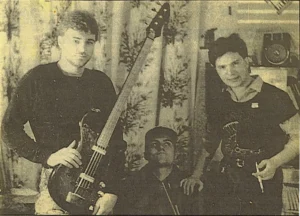
Photo of DMT from a newspaper article dedicated to the anniversary of Dunaev’s death
The band formed in early spring 1988. Later, the drum machine was replaced by drummer Anatoliy “Korifan” Voitovskyi, and the lineup effectively settled into a trio.
Together, they would record four albums and perform several concerts. “Several”— a number that, in hindsight, was far too few given the unfavorable times for their creative work. As Igor Pachev later recalled,
“He was constantly meeting with official journalists, composers, and festival organizing committees. I have to say, they were all secretly afraid of him!!! He’d give them ‘demo recordings’ and call them. In short, everyone knew DMT—from the lowliest punk to the head of the Composers’ Union!!! Officials feared us like the plague. The situation was spiced up by scandals at our concerts (well, at least that was fun).
They never invited us back a second time. They were afraid the punks would burn down the venue and so on. Dunya craved official recognition desperately. To achieve this, at concerts he would slash his chest with a razor, yell from the stage at members of the jury or the organizing committee, and pull off other such “charming” little stunts. In his mind, it all made perfect sense :-)”
You need your mind exploded. Otherwise, what’s the point of rock ’n’ roll? — from an interview with T. Yezhova (February 1990)
Given all the difficulties, the band’s collaborative work effectively came to an end in 1993 after recording several songs for the album Samobalzamirovanie. Shortly before that, Dunaev had spent a long time in the hospital—so it didn’t seem possible to be very active, and there was no interest from the public either — the young country was engulfed by a financial crisis, so concert attendance had effectively dropped to zero.
However, according to Pachev, no one ever abandoned the DMT brand — the band members’ solo work was automatically considered part of the band’s body of work, which totaled over 30 albums (most of which were recorded independently by Dunaev). So DMT exists — it exists as long as Pachev and Voitovsky are around.
Rock Operas
Perhaps inspired by his love for Nina Hagen, Dunya created as many as three rock operas during his lifetime.
He recorded “The Trial” (1993) and “Aderaid” (1994) essentially as solo operas based on librettos written by his wife. As far as I know, the musical history of Ukraine and abroad knows nothing (or very little) about punk mono-rock operas—so Dunya and Lyubov became the de facto pioneers in this field.
The last rock opera was “Peklorida,” also known as “Aderida II.” Unlike the previous two, this one was a collaborative effort: in addition to Dunya and his wife Lyubov, Lyubov’s sister—Veronika Ivleva (incidentally, a relatively well-known astrologer in the 1980s)—as well as Yevgen Boiko, Dmytro Nikishin, and the rock band “Khrbty” worked on the recording.
The roles were roughly distributed as follows: Author, Stranger, Actor, Life — Gena; Time, Space, Charon, Punk Martian, God — Yevgen; Angel and Nature — Veronika.
In fact, this “punk opera” lasts about half an hour, and then Dunya added his own songs as a bonus, performing them himself (starting at the 31-minute mark)… From the way these “arias” are sung, it’s clear that the performers (including Dunya) are seeing the lyrics for the first time 🙂. The musical part was almost entirely improvised over the course of a couple of hours (of course, without any “overdubs”; Dunya played the keyboards and sang—wherever a tenor or falsetto was needed). Ah, if only we’d had a little more time, a studio, and a bit more flair back then, we could have produced an interesting psychedelic-punk track. — From the memoirs of Yevhen Boiko
Fortunately, this recording has been preserved. Listen to it at the link:
Conversations with Kosakivsky and Politics
With this story, we’re venturing somewhat into the realm of legend, since there is no freely available documentary evidence (such as the relevant article by Svitlana Fesenko, which was supposedly published in the newspaper “Vechirniy Kyiv” in July 1995).
As Pachev recalled, Dunya often called in to radio stations—and particularly enjoyed chatting with Vesklyarsky. Gena loved organizing various radio events. Once, he called in live during an interview with Leonid Kosakovsky — then head of the Kyiv City State Administration. It is said that Kosakovsky claimed to be well-versed in rock music—so Gena decided to ask him a few questions about the Kyiv rock scene. Kosakovsky reportedly did not answer them, but promised to make their names more famous than his own.
In general, politics was no stranger to Dunaev. In 1987, he won first place at a political song festival and competition, and throughout his life he repeatedly returned to political themes in his work. And although in an interview with Tetyana Yezhova he said, “Personally, I’m a centrist leaning to the left. I’m equally indifferent to both Nazis and Communists,” it’s hard to believe — he returns to the theme of anti-communism far too often in his works. .
..Fascism may be unsavory, but communism is nonsense — he sings in the song “Punish America!”
The King of Lost Media
Perhaps Gena Dunaev would be better known around the world — at least on par with Letov, whom he knew and spoke highly of — if not for one huge problem: most of his recordings have vanished without a trace.
This applies to all stages of his career—from his final recordings, such as the album Optimistic Symphony, recorded in 1996 with the rock band “Snegiri” — which was even planned for release on CD — as well as his early cassette albums, recorded during or immediately after he finished school.
Some were lost, some were never re-recorded — and were subsequently lost as well. To be honest, we don’t even have an exact discography — he had so many albums that it’s impossible to determine the exact number today.
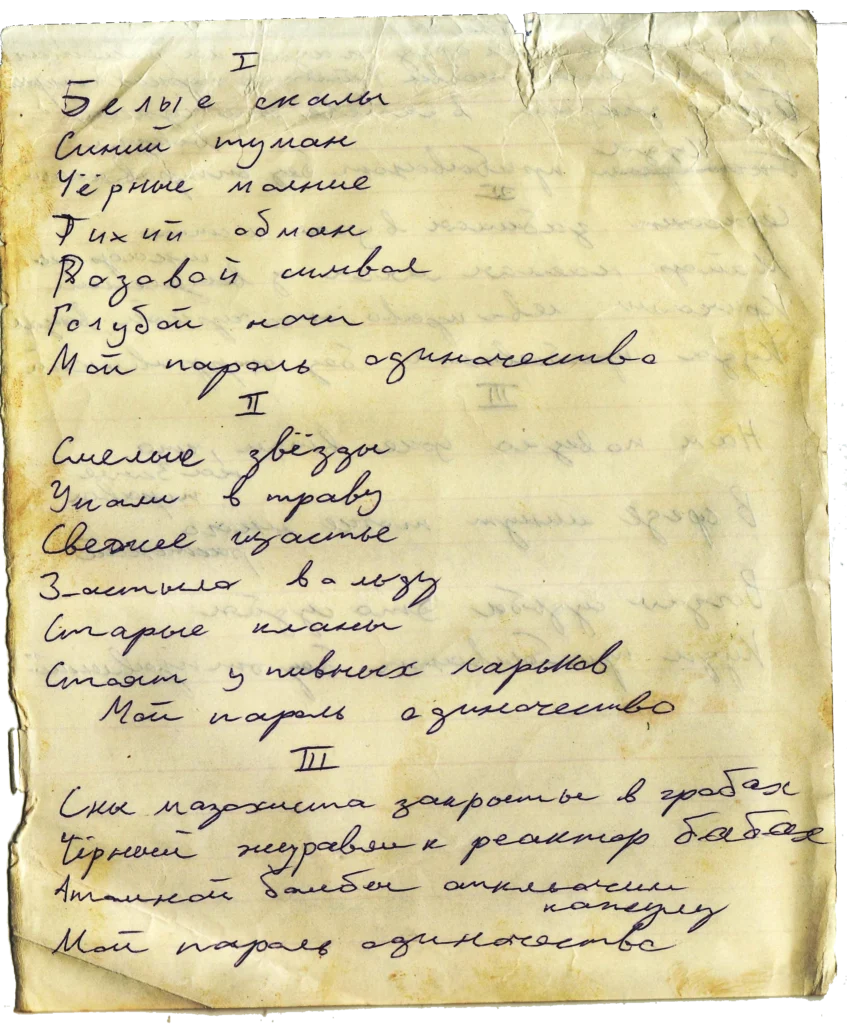
A list of DMT’s albums, written in the handwritten “DMT Holy Scripture” for issue No. 4 of Guchnomovets
We find individual song excerpts in the only (so far) book about Dunaev, written by his wife, Lyubov. There, as well as on LiveJournal and Facebook, we find scattered memories of him, from which we can partially piece together his biography. But when you read all of this, you constantly get the impression that Dunaev deserves more—and you immediately understand why he believed he was perpetually unlucky. Perhaps one day he’ll receive a fraction of the fame he craved—even if it’s decades after his death.

Want to publish your article on Zirochka?
Submit it via the form, and we’ll publish it on the website
-
 # Lost media
Де Автанділ бл*? Як загадкова касета спровокувала розшук року
# Lost media
Де Автанділ бл*? Як загадкова касета спровокувала розшук рокуРік тому в інтернеті з'явилася касета з загадковим хіт-парадом. З того часу інтернет-детективи витратили багато часу, намагаючись з’ясувати більше деталей — але без особливого успіху.
-
 # Animation
Kraków Animation School for Beginners
# Animation
Kraków Animation School for BeginnersA brief introduction to one of the most interesting animation schools in Central and Eastern Europe
-
 # Internet history
In memoriam: Jason dinAlt (1984–2016)
# Internet history
In memoriam: Jason dinAlt (1984–2016)Kurka Aalyamb, Maksym Udynskyi, and Les Yakovyshyn share their memories of Oleksiy Panchuk—the creator and head administrator of the Uchan imageboard and a pioneer of Ukrainian-language internet culture, who died 10 years ago.