The 1997 Kyiv Declaration: a Retrospective
Delegates from eighteen European countries met in 1997 in Kyiv to draw up the principles of young European social democracy. Does the document still hold up?
The Kyiv Process should be seen not as a discussion in its own right, but as a point of departure — the first step in a common undertaking by European socialists. Our declaration can serve as the basis for a programme of joint political action, one that will be reflected in what we do at the national level. That means the Kyiv Process must become the instrument that brings us together for common action on those questions where we already stand as one.
— Thilo Krah, member of the Federal Executive Committee of the Young Socialists in the SPD
The end of December 1997 was an unusually prolific moment for European socialists. Between 19 and 23 December, forty delegates from eighteen European youth organisations gathered in Kyiv, the capital of Ukraine, and produced a joint document that summed up years of argument and was meant to serve as a compass for social democrats stepping into the third millennium.
For the first time in history, representatives of socialist and social-democratic organisations from Western and Eastern Europe were brought together to work on the paper. A sharp contrast with 1976, when the Socialist International had effectively left the socialists of Central and Eastern Europe without a voice on the international stage, Ukrainians, Latvians and others were making sure their voices were being heard.
Five themes were chosen for discussion during the Kyiv process:
- Human rights and democracy
- Economic and social policy
- Peace policy
- Youth and education policy
- Ecology
Across fifteen pages, dozens of propositions captured young social democrats and socialists at their most radical. Thanks to this document resurfacing at the International Institute of Social History in Amsterdam, we can finally see the kind of world young socialists envisioned in the 1990s.
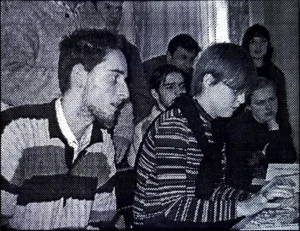
Lisa Pelling (Sweden) chairs a working group; beside her on the left, Marko Tomić (Croatia)
Where the declaration stood
The declaration opens with a double refusal. First, it rejects the communist understanding of “people’s democracy”, which, it says, “distorted the idea of freedom and of the emancipation of women and men” by asserting a false identity between state and citizen, “treating social rights without regard for the rights to freedom”.
Second, it rejects the “liberal-conservative conception of national civil rights”, which guarantees freedom “only formally”, without regard for “the socio-economic position of women and men as a condition of freedom”, and so opens the way to “manifold economic injustices and a poverty unworthy of human beings”.
The Declaration states its own position plainly: an understanding of rights that requires “not only individual freedom, but also solidarity and social guarantees for all”. Three principles are declared “inviolably valid always and everywhere”. The first is basic rights and the protection of the individual, under which “all state and economic power… is subject to public control”. The second is the right of everyone to take part in the life of society, to social security and to work. The third is representative democracy with scope for direct democracy, “at the national as well as the international level”.
To the authors of the Declaration, democracy does not stop at the factory gate: public control, they say, must exist wherever power over people’s lives is concentrated. This is the single premise that drives nearly every demand the declaration makes — of employers, of the ECB, and of the forces of privatization then reshaping the continent’s East.
Human rights
“All forms of cohabitation, including homosexual marriages,” the delegates agreed, “must be placed on an equal footing with the institution of marriage.” When they wrote that sentence, not one country in the world recognised same-sex marriage.
A few lines above it sits a shorter and more unexpected sentence: “Everyone has the right to change their sex.” In 1997 this hardly figured as a demand anywhere in European politics.
Free access to contraception and abortion appears not as a separate contested question but as part of the right to life itself, set in the same sentence as liberty, privacy and bodily integrity. That construction turns the usual terms of the abortion debate upside down: restriction, rather than access, is what stands opposed to life.
The most maximalist passage concerns movement. “Everyone must be granted the right to choose where they live,” the text declares. “Visas violate the right of every person to free movement.” The right to asylum belongs not only to those persecuted for political reasons but to anyone compelled into military service, anyone whose free choice of a marriage partner is restricted, and anyone “threatened by ecological danger”. That last clause is a right for climate refugees, formulated decades before this idea entered the political mainstream.
Residence shades into belonging. Every person has “the right to obtain the citizenship of the country in which they live”, and the section on political rights goes further, demanding the right to vote in one’s region and state “regardless of whether or not one holds that state’s citizenship”.
One more provision is buried here, easy to miss: “No person may be questioned by state authorities or by employers about their religious and political convictions or their sexual orientation.” Two words, “or employers”, carry the opening premise across into the catalogue of rights. A manager is bound by civil liberties exactly as the state is.
This section is the work of forty people writing by unanimity over five days, and it shows. Some of the formulations are unworkable as written.
The economy: a pre-emptive rejection of the Third Way
In the economic sections the declaration becomes a consistent, point-by-point answer to documents that had not yet been written. At its centre is a prohibition. “No one may be forced to accept a job or undergo a retraining programme as a condition of receiving unemployment benefit.”
The sentence appears in the section on basic rights, and then, alone among the declaration’s hundreds of demands, appears again in the economic section, sharpened: “we firmly oppose models under which people are forced to accept a job or a retraining programme as a condition of receiving unemployment benefit”.
Whoever assembled the surviving archival copy ran a highlighter over the first instance. They had reason to. Eighteen months later the Blair–Schröder paper would make “rights and responsibilities”, benefits conditional on taking work, the watchword of European social democracy.
Five years after that, the SPD, whose youth wing ran the Kyiv Process and part-funded it, legislated into being the very mechanism its own young members had rejected twice. The declaration did not merely anticipate the Third Way. It said no to it in advance.
There is an argument behind the refusal. The unemployment section names its enemies: it rejects the claim that “a minimum level of unemployment is necessary to maintain competitiveness”, a doctrine it does not name outright but one that was just then hardening into common sense for central banks; it rejects the assertion that “flexibility and deregulation are the key means of creating jobs”; it rejects the line that unemployment “is not a problem, since it is largely voluntary”. The counter-argument is political rather than technical: “The political and economic toleration of unemployment is the greatest obstacle to reducing it.” Mass unemployment, on this reading, is a choice dressed up as a natural rate.
The programme built on that foundation has had the strangest afterlife of anything in the document. Keynesian counter-cyclical intervention, the text argues, must operate “at least on a European scale” if it is to have any purchase on a global economy. It cites Jacques Delors’ White Paper directly, demands the extension of the Trans-European Networks into Central and Eastern Europe, and specifies the financing: through the European Investment Bank and the European Investment Fund, “by issuing Eurobonds”. That word, in a youth document from 1997.
When the European Union finally issued common debt, €750 billion of it under NextGenerationEU in 2020, the instrument arrived under a politer name, but the delegates in Kyiv had drawn its blueprint back in 1997, down to the issuing institutions. And they identified the obstacle: “we oppose the Maastricht deficit and debt limits, which make such programmes impossible”. It took the eurozone a sovereign debt crisis, a lost decade and two suspensions of its own rules to reach the same conclusion.
Their proposed remedy was “a European economic government to control the ECB”, answerable for employment, growth, price stability and social progress, and accountable to the European Parliament. It remains the famous missing half of the euro: the currency still has a central bank without a treasury and a monetary policy without a demos.
Underneath all of it lies an analysis of globalisation, crude in its mechanics and right in its direction. “Today around 80% of capital circulates on speculative markets,” the text asserts, a figure best left unchecked. This sets off “a spiral of cheapening” in which “states and companies compete by driving down wages”, while the trade unions, “still operating only at the national level, find no answer to the international mobility of capital”. Set the percentage aside and what is left is an account of financialisation and social dumping that respectable economics reached a decade and a half later, once the crash had made it decent to cite.
The most original economic thinking came from the eastern delegates, and it fits no Western template at all. On privatisation, the defining policy of that decade, the declaration offers a sequence rather than a principle: “only the worst and least efficient enterprises should be privatised”; profitable state enterprises “must be protected rather than privatised, since they are a sound basis for social guarantees”. Ownership is the wrong variable, it argues, because “for efficiency it makes no real difference whether a firm is state-owned or private. Efficiency depends on how it is managed”. Central planning is dismissed in the same breath as “a communist relic”.
This is a critique of shock therapy written from inside the shock: keep the tax base, sell the ruins, judge managers by results. It matched neither the Washington Consensus nor Western social democracy’s accommodation with it, and that may be why nobody picked it up.
Not everything here survives close inspection. A right to strike “without limitation, including for political purposes” would leave any government hostage to any trade union confederation. A 32-hour week “with mass purchasing power maintained” assumes that wages can simply be declared. A constitutional “right to work” commits society to outcomes no constitution can deliver.
The excesses are worth naming, because they certify everything else. The document was not planed down to whatever seemed achievable at the time, and so it records, unretouched, what the left believed before the age of the Third Way: some of it running a quarter of a century ahead of the consensus, some of it plainly unworkable, and the line between the two invisible at the time to everyone on either side of the argument.
Peace, youth, the United States of Europe
The peace section is the one place where the declaration’s unanimity rule visibly splits at the seams. On one page it concedes that NATO “still plays an important role in the defence of some European countries”. A few paragraphs down it commits, in the long term, to “dissolving NATO and building a global security system”. Both sentences were adopted by consensus, and one can guess how. The delegates from Warsaw, Budapest and Prague, whose countries had been invited to join the alliance five months earlier, presumably stood behind the first; others, further from Russia geographically or further left politically, behind the second; and “in the long term” did the diplomatic work of an escape clause. The page does not settle the argument of the 1990s. It preserves it, deadlocked and sealed in.
What makes the section hard to read now is not what it got wrong, but how much it got right on the way to getting it wrong. “Every country’s interest lies in the security of its neighbours.” Security “cannot be a matter for individual states. It is an international question.” The text condemns “geopolitical hegemony and the division of Europe into spheres of influence”, rejects integration used “as an instrument of pressure by one state upon another”, and insists that any European security architecture “must integrate both Russia and the countries of Central and Eastern Europe”. The premises were sound. The forecast was not: a post-military world underwritten by a reformed UN, with war “outlawed” as something that is always “the consequence of political failure”. And they were writing those lines in Kyiv.
The youth section is the document with its guard fully down. Here the ideal is named without a trace of embarrassment: “Our ideal is a classless society.” Schools are to bring up “conscious and active citizens, not simply to cultivate an entrepreneurial mindset”; they must teach “critical thinking” and “creative intellectual independence”. It is a curriculum built, sentence by sentence, as a direct negation of the employability doctrine that was about to conquer Europe’s education ministries.
Tucked into the passages on employment, workfare returns dressed as youth policy: “It is not sanctions that can encourage employment, but the creation of the conditions and services that allow young people to become more ’employable’.” The scare quotes around that last word are doing a great deal of work. Enable, do not compel: the declaration’s central idea, restated for its own generation.
The conclusion gathers all of it up and names the destination: “a federal state of Europe with direct democracy and a multicultural society”, in which national sovereignty is “partly pooled”, because ecology, poverty and justice are “questions on which the survival of humanity depends”, and because “the currently dominant doctrine of the Europe of the internal market, as the liberal-conservative conception envisages it, cannot meet these challenges”. That last verdict is the hinge of the section and of the era. Their answer to globalisation was more Europe, democratised and whole.
What the following decade handed them was more of the market Europe instead: enlargement without a social union, a single currency without an economic government, and the internal market as the one doctrine left standing. The federation they imagined never arrived. The Europe they warned about did.
The balance sheet
Set the declaration beside the quarter-century that followed it, and two columns form almost by themselves.
The column of things achieved is long. Marriage equality, demanded at a time when it existed nowhere on earth, is now law across most of the map the signatories came from. Gender self-determination entered German law in 2024, twenty-seven years behind the party’s own youth wing. Common European debt, the Eurobonds named and specified in Kyiv, arrived in 2020 to the tune of €750 billion under the NextGenerationEU banner. The Maastricht deficit rules they opposed have been suspended, broken, reformed, and quietly stopped being believed in. Working-time reduction, which they wanted imposed by directive, is now trialled by consultancies. Public investment and industrial policy, heresy in 1997, are respectable in 2026.
The column of things unachieved speaks just as loudly. The visa-free world never came; Europe built its exact opposite. The 32 hours themselves remain a demand and nothing more. The United States of Europe looks further off than it did when they were writing about it. And “in the long term we believe in the dissolution of NATO” is the sentence in the whole document that has aged worst.
Run a finger down both columns and a pattern emerges that is worth more than any single item. What came true were the demands that widened individual rights or expanded fiscal capacity, the ones that could be absorbed without disturbing the distribution of economic power. What died were precisely the demands that touched that power: unconditional benefits, the right to strike, keeping profitable state enterprises in public hands, an economic government accountable to parliament. The declaration’s founding premise, that democracy’s mandate extends to economic power and not to state power alone, is the one proposition that appears in neither column, because nobody ever tried it.
Which brings us to the comparison. The Blair–Schröder paper answered the same questions eighteen months later, won the decade and governed the continent. Its central doctrines — workfare, labour-market flexibility, austerity — have aged far worse than most of what forty young delegates agreed unanimously in a Kyiv winter.
Nobody calls the winning document prophetic. The losing one turned out to be the better forecast, and the proof is that its demands keep coming true: late, under other names, and with the credit going to other people.
The text ends with a vision: “An open and humane Europe in a world of solidarity and ecological responsibility is the vision and the goal of our politics as the young socialists and social democrats of Europe!” As a political project the Kyiv Declaration failed completely. As a record it is unmatched: a cast of what European social democracy believed in the last moment it was still allowed to dream, before the future it had drawn was cancelled and then handed back in offcuts, one piece at a time.

Want to publish your article on Zirochka?
Submit it via the form, and we’ll publish it on the website
Схожі матеріали
-
 # Social democracy
Yevhen Marchuk, a Social Democrat?
# Social democracy
Yevhen Marchuk, a Social Democrat?In 1999 he ran as the centre-left candidate, a fact Ukraine has since forgotten. Does Marchuk belong in the history of Ukrainian social democracy?
-
 # Social democracy
Дороті Еммет і моральне підґрунтя соціал-демократії
# Social democracy
Дороті Еммет і моральне підґрунтя соціал-демократіїЗабутий памфлет 1985 року пояснює, чому моральну політику неможливо побудувати самими указами.
-
 # Social democracy
Обіцянки манчестеризму
# Social democracy
Обіцянки манчестеризмуІм'я нового Прем'єр-міністра Великої Британії пов'язують із філософією "манчестеризму". Що воно є і чи час діставати конспекти?