Yevhen Marchuk, a Social Democrat?
In 1999 he ran as the centre-left candidate, a fact Ukraine has since forgotten. Does Marchuk belong in the history of Ukrainian social democracy?
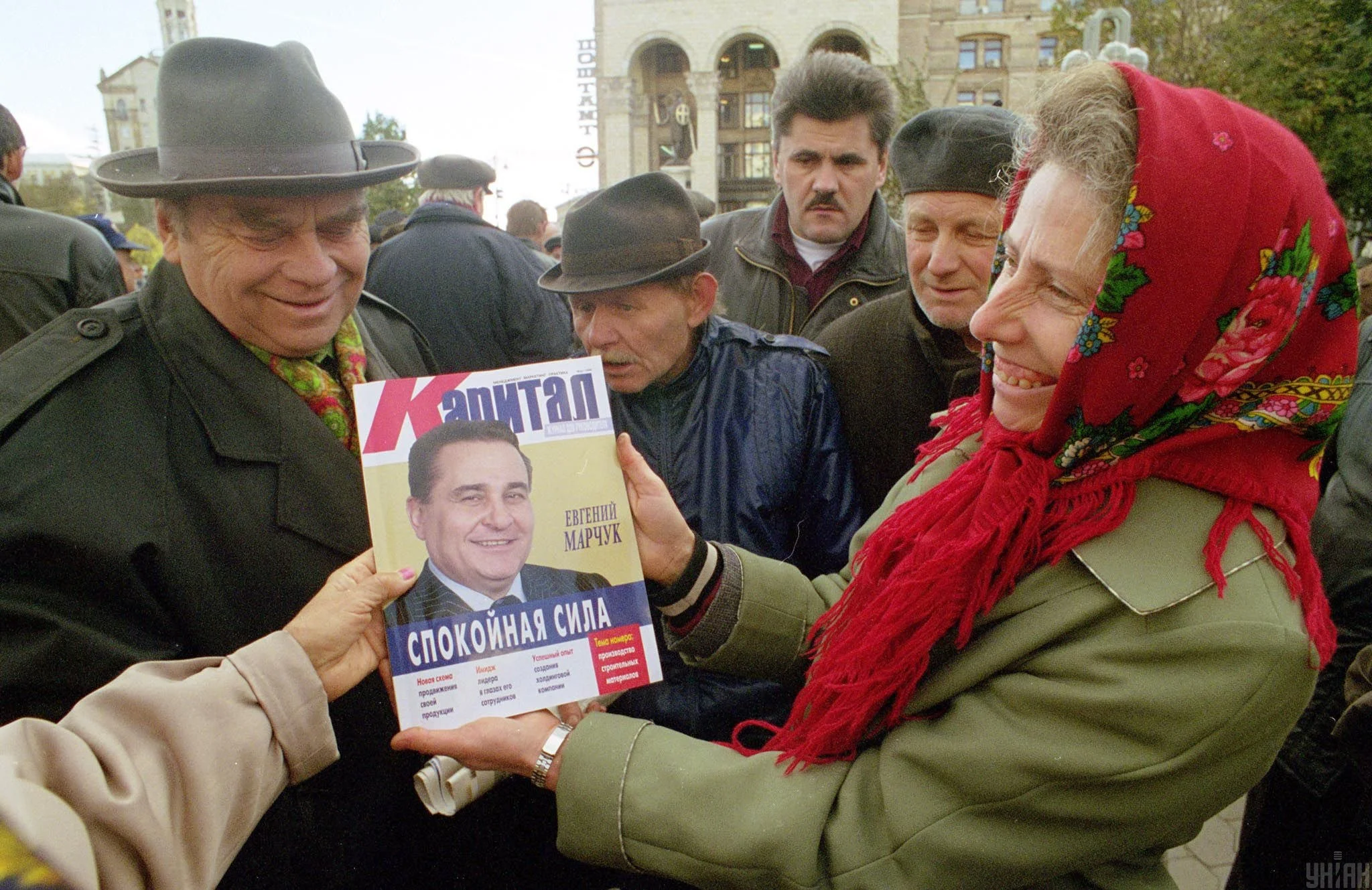
Most Ukrainians who remember Yevhen Marchuk at all remember him either as the first head of the Security Service of Ukraine, or as Secretary of the National Security and Defence Council during the 2003 standoff with Russia over Tuzla Island. So much has been written about those two posts that it has crowded out the story of Marchuk the politician.
Marchuk can fairly be regarded among the most important political figures of the long 1990s. In 1995, at an extraordinarily difficult moment for the young state, he took charge of the Cabinet of Ministers; within a year the President had dismissed him for “cultivating a political image of his own”. Political pundits predicted a future presidency for him. Three years later he ran for it, and the campaign collapsed.
Why did Yevhen Marchuk lose in 1999? The reasons are plenty: the anti-Kuchma opposition could not agree on a single candidate, the count was falsified on a mass scale, and regional campaign managers faced intimidation and arrests. The result was 8.13% for Marchuk in the first round. Petro Symonenko, the Communist leader who went through to the run-off against Kuchma, took nearly three times as many votes.
Those two million votes, and the campaign that produced them, nevertheless still matter to the Ukrainian centre-left. For Yevhen Marchuk entered the presidential race precisely as a social-democratic candidate, and to this day he remains the most successful Ukrainian centre-left figure ever to run for head of state.
A strikingly wide range of politicians and public figures campaigned for him: former dissidents such as Yuriy Badzyo; the nationalist leaders Slava Stetsko and Levko Lukyanenko; the popular, and controversial, singer Mykola Mozghovyi; and Mykhailo Krylov, who led the mid-1990s Donbas miners’ movement. How did Marchuk assemble a coalition like that? The answer, I believe, lies in two things: his political biography and his programme.
“Marchuk is neither Left nor Right; he is simply right.”
A career officer of the Ukrainian SSR’s KGB is not the most natural figure to unite a progressive political movement. Yet by many accounts it was inside the Committee that Marchuk’s disillusionment began, first with the Soviet system and then with the communist idea itself.
Most accounts of his KGB service say he took no part in the repression of cultural figures. Newspapers from the 1990s carry statements from people convicted under the regime describing how he shielded the persecuted from unfounded charges. Perhaps it was no coincidence that the declassification of the archives later fell to him.
IIn the 1980s he took charge of the individual rehabilitation of thousands of victims of repression, and was among the first to read the files on the great fabricated cases: the “Union for the Liberation of Ukraine” trial, the case of the former “Borotbists”, and many more.
His sympathy for the anti-Soviet currents of the left took shape in these years. Lieutenant General Oleksandr Khrystenko, who served under Marchuk in the KGB directorate for Poltava Oblast, later recalled that his boss would pass trusted colleagues material on three currents in particular: Eurocommunism, left-wing Zionism, and the Ukrainian national communism of the 1920s and 1930s.
Did he ever wonder what the Ukrainian left might have become had the Russian Bolsheviks not crushed it? Had he by then concluded that democracy was a precondition of prosperity? There is no way to know. His commitment to democratising and de-Russifying Soviet Ukrainian politics and society, though, was no secret.
In 1990 he won the first election he ever stood in and became a deputy of the Poltava Oblast Council, where activists of the Democratic Platform, the reformist wing inside the Communist Party, reportedly wanted him to head the oblast party committee. Nothing came of it though: that same year he moved to Kyiv.
Yet Marchuk repeated the Poltava result soon afterwards. Standing for the Verkhovna Rada while serving as Prime Minister, he won almost 90% of the vote in a 1994 by-election in Myrhorod.
In parliament he joined the “Social Market Choice” group, de facto led by the Donetsk millionaire and Liberal Party politician Yevhen Shcherban.
The twenty-five deputies stood, as the name suggested, for pairing market reform with social protection: a Ukrainian model of the social market economy. What the group did over its four years deserves an article of its own — what matters here is that Marchuk’s central slogan took shape during his time in the faction and later at its head, though he only put it into words in 1999: “It is the economy that should be a market, not society.”
The unexpected murder of Yevhen Shcherban in November 1996 left Marchuk looking for new allies before the 1998 parliamentary elections. He found them in the Social Democratic Party of Ukraine (united), standing second on its list, immediately behind Leonid Kravchuk.
“It is the economy that should be a market, not society.” — one of Marchuk’s central political slogans
As a SDPU(o) deputy he chaired the Rada’s committee on social policy and labour. Controversially, it was under his chairmanship that parliament passed the Law “On Trade Unions”, which the independent unions attacked for restricting the right to organise.
The law deserves a discussion of its own: it passed after a series of vetoes by President Kuchma and in breach of Article 36 of the Constitution. One detail is telling. When the SDPU(o) and Labour Ukraine backed the presidential push against trade union freedom, Marchuk demanded a roll-call vote, so that each faction’s real position on workers’ rights would be on the record.
He also made no secret of his disagreements with the party leadership, not least on language. His position on Ukrainian as the sole state language was unshakeable, he recalled in a later interview, and that of the party’s leaders was not. As a result of the numerous disagreements, he lasted about seven months in the SDPU(o) faction, never joining the party itself, and then sat as an independent.
His departure did not cost him the following. In 1999 Volodymyr Maksymovych, head of the SDPU(o) Odesa regional organisation, claimed that around 70% of SDPU(o) members wanted Marchuk as the Social Democrats’ presidential candidate.The party leadership saw things differently: its chairman, Viktor Medvedchuk, declared support for Kuchma.
Out of the split between Marchuk and Medvedchuk came the Social Democratic Union, which, together with the All-Ukrainian Association “People’s Solidarity”, became the backbone of former’s 1999 presidential campaign.
What was Marchukism?
On 3 February 1999, Marchuk told the “Council of Chairs of SovereigntistNational-Democratic Parties”: “Every nation has an ideology intrinsic to it. The ideas of social justice and national solidarity were, are and must remain, together with Christian morality, the cornerstones of the ideology of Ukrainianness.” The passage sets out the core of Marchukism plainly enough. It was a historical variant of social democracy in Ukraine.
His speeches, interviews and articles from the campaign make it possible to reconstruct what he understood social democracy to mean in a Ukrainian context. Marchuk and his speechwriters had read the politicians of the Third Way, as one would expect in 1999, but the milieu around him was far more sovereigntist and far more open to a moderate nationalism. It is no accident that de Gaulle appears on Marchuk’s list of inspirations. The continental European parties reached social democracy by deradicalising, travelling from orthodox Marxism to ethical socialism. This one arrived from the opposite direction: a national democracy that had moved left.
Marchuk himself insisted: “Social democracy cannot remain sterile — it must be enriched by national-democratic traditions.”
What did he offer voters? Above all, an argument that lawlessness was the chief driver of inequality. If the common good were ever to become genuinely common property, the president would have to repair the system and go hard at crime and corruption, even to the point of capping wealth at the level where a fortune stops improving anyone’s quality of life and starts functioning as an instrument for subverting politics.
Marchuk insisted: “Social democracy cannot remain sterile — it must be enriched by national-democratic traditions.””
He also proposed writing trade union oversight of wage payment into law, making the unlawful withholding of wages a criminal offence, and banning pyramid schemes and predatory lending of every kind.
To ease what the decade had done to ordinary Ukrainians, he wanted to clear post-Soviet red tape away from small and medium-sized business and open state credit lines so that Ukrainian producers could reach finance. Together with the abolition of VAT on essentials, childcare products among them, this was meant to give young Ukrainians a chance to start a business of their own and a fair way into the market.
The Social Democratic Union billed its platform as a programme of comprehensive reindustrialisation. The state, Marchuk argued, had to build “a system of distributing wealth that stimulates production” rather than one that merely subsidises consumption. He was prepared to fight the IMF over it, above all where Ukraine’s economic and energy sovereignty was at stake.
He wanted a thorough investigation of the illegal privatisations of the decade, and flatly refused to rule out renationalisation where strategic assets had been plundered.
Against the advocates of “shock therapy”, Marchuk’s social democrats proposed a guaranteed employment programme aimed at unemployment among the young and among women. For women he set out specific guarantees of work, decent pay and social protection, so that “the transition to a market economy would not take place at the expense of half the population”.
Social democracy, as Marchuk understood it, rested on two foundations: respect for the dignity of labour, and the defence of national identity. The second, as one would expect from a former security officer, he treated as a question of national security. His programme covered support for culture and the arts, a comprehensive scheme for the repatriation of the diaspora, and support for Ukrainian life beyond Ukraine’s borders, with the Ukrainians of the Kuban, in southern Russia, singled out for mention.
Social democracy after Marchuk
However interesting the platform may look to centre-left Ukrainians today, it lost in 1999, and that makes it impossible to judge how much of it could have been implemented, or how Marchuk himself would have gone about it. His era recedes further into the past every year, and he still means very different things to different people. For some he is the great missed chance. For others, his early-1990s dealings with the oligarch Boris Birshtein still count against him, along with much else..
Can a Ukrainian left-wing national democracy survive without its architect? Marchuk’s defeat in 1999 cost it the Social Democratic Union, and with it any institutional form. But if today’s polling is anything to go by, it has not lost its voter: someone still troubled by inequality and low wages who nonetheless holds statist, patriotic views. Winning that voter over is a job waiting for the postwar years.

Want to publish your article on Zirochka?
Submit it via the form, and we’ll publish it on the website
Related
-
 # Social democracy
The Rebirth of Ukrainian Social Democracy in Lviv
# Social democracy
The Rebirth of Ukrainian Social Democracy in LvivIn the late 1980s, a group of young idealists undertook one of the first efforts to resurrect social democracy on Ukrainian soil. Discover the history of this endeavour in our feature.
-
 # Social democracy
The 1997 Kyiv Declaration: a Retrospective
# Social democracy
The 1997 Kyiv Declaration: a RetrospectiveDelegates from eighteen European countries met in 1997 in Kyiv to draw up the principles of young European social democracy. Does the document still hold up?