Międzymorze: A Journal of Polish–Ukrainian Solidarity
The story of a Warsaw samizdat journal Międzymorze — and of the method of Polish–Ukrainian cooperation that it left behind.
The Intermarium is a geopolitical project for uniting the independent states of Central and Eastern Europe into a powerful alliance between the Baltic, the Black and — sometimes — the Adriatic seas, intended to guarantee the region’s collective security and its independence from larger geopolitical players.
In Ukraine today, the Intermarium belongs to the Right; its best-known advocate was Oleksandr Maslak (1977–2017). In the second half of the last century it belonged to a very different quarter: the democratic socialists.
By the early 1980s, several of Poland’s underground socialist organisations had adopted some version of a federalist Intermarium programme. The best known of them was a pamphlet issued by the organisation Robotnicza Solidarność — Wolność, Sprawiedliwość, Niepodległość (Workers’ Solidarity — Freedom, Justice, Independence): Polska i Międzymorze. Wokół dróg działania i programu przyszłości — Poland and the Intermarium: On Courses of Action and a Programme for the Future.
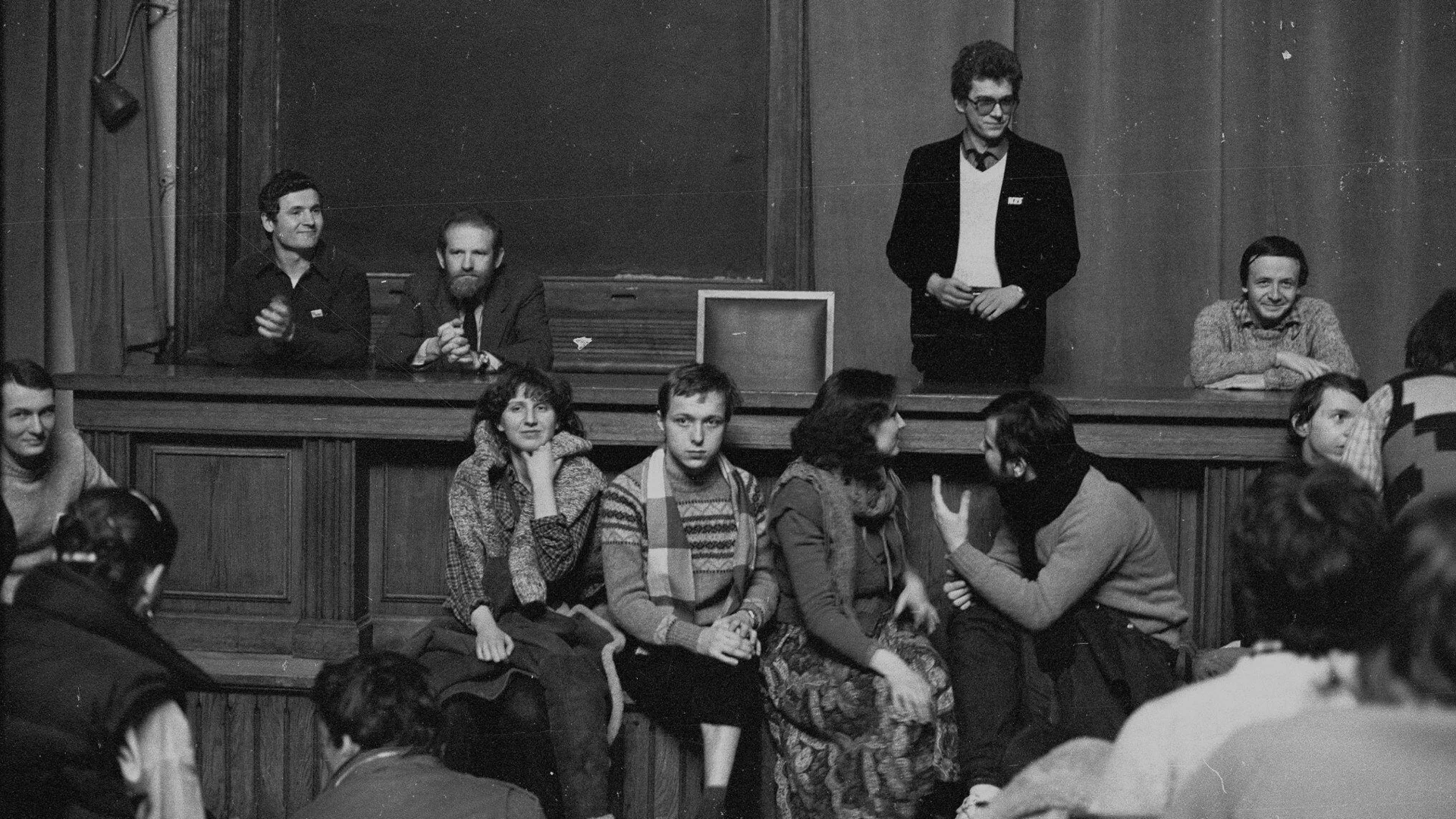
The most consistent expression of a left-wing Intermarium idea, though, was not a pamphlet but a journal: a samizdat periodical produced between 1987 and 1989 by a group of Warsaw University students in the orbit of the revived Polish Socialist Party (PPS).
A student initiative inside the PPS
The party’s young members, gathered around the socialist circle at Warsaw University, set out to fill what struck them as a critical gap. The PPS, revived underground in Poland a few months ago, had no worked-out position on eastern policy at all — nothing on Ukraine, nothing on Lithuania or Belarus.
And so in 1987, on the initiative of Tomasz Szczepański, a history student, Międzymorze came into being. It would cover the national question across the countries of the socialist bloc and open a debate inside the PPS about cooperation among the states of the Intermarium: Poland, Ukraine, Lithuania and Belarus above all.
Besides Szczepański, the editorial board consisted of Joanna Strzelczyk (writing as Kamila Azowska), Jacek Giżyński and Katarzyna Parzychowska (as Emi); Tadeusz Andrzej Olszański (Jan Łukaszów) and Tomasz Marek Leoniuk also contributed. They were all much of an age, though a few of them — Giżyński and Olszański — already had a good deal of underground experience behind them.
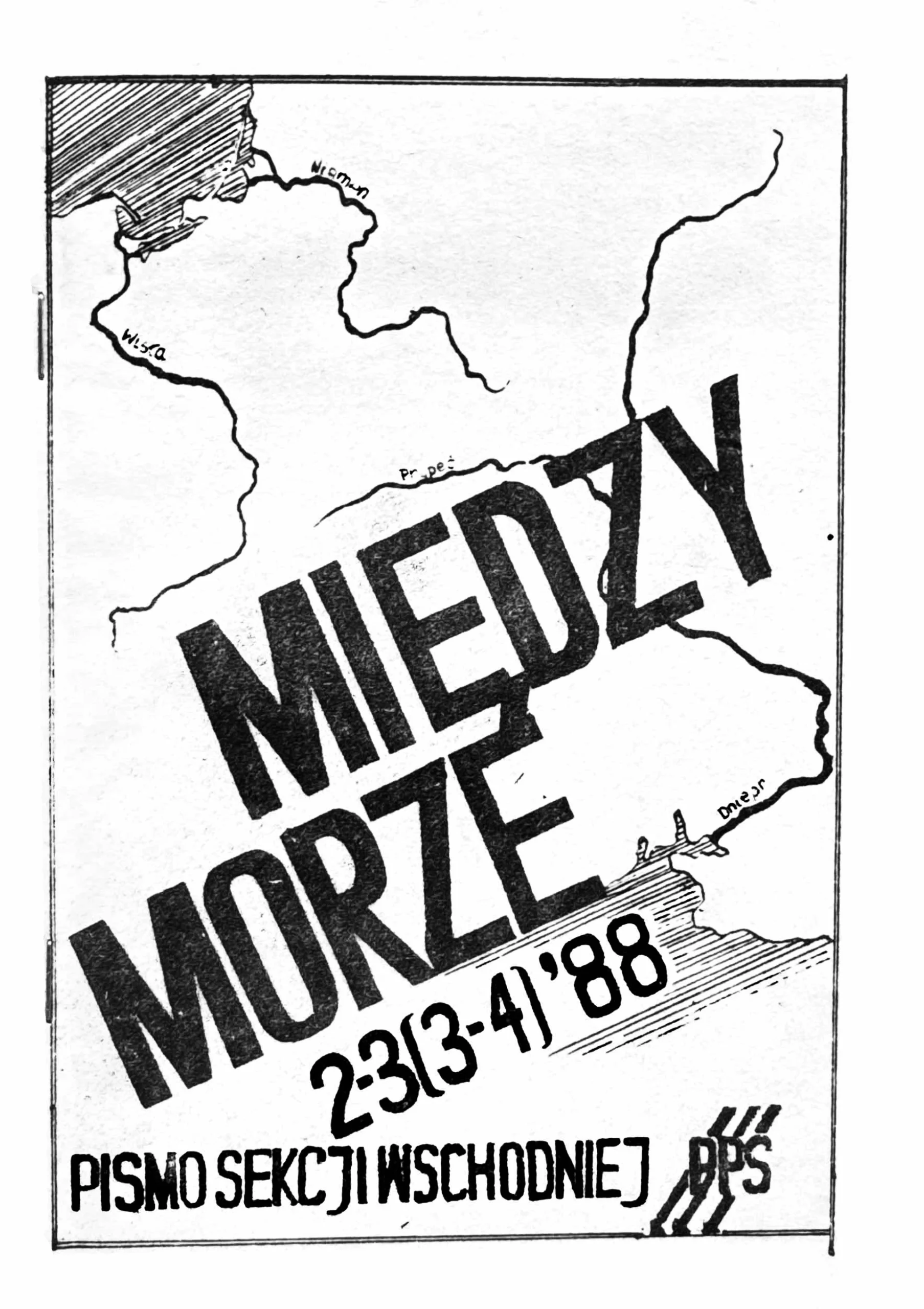
The cover of a double issue of Międzymorze.
Five issues appeared in all, each running to between forty and sixty A5 pages. The cover showed the outline of Central and Eastern Europe framed by four rivers: the Vistula, the Neman, the Prypiat and the Dnipro.
The editorial in the first issue set out the founding purpose: cooperation among the peoples of the Intermarium, from the Baltic to the Black Sea, in the cause of liberation from Soviet rule. Olszański’s essay Międzymorze — czym jest, czym może być? (The Intermarium: What It Is, What It Might Be) gave those general claims some substance, and can reasonably be called the programmatic manifesto of the whole group.
Olszański defined the Intermarium as a cultural, historical and civilisational space bounded by the Baltic, the Adriatic, and the Black Sea — a space that mapped, geographically, onto Central and Eastern Europe. What held this “Slavic community” together, on his reading, was not only a common culture but a common history: fear of German hegemony, pressure from Ottoman Turkey, and opposition to Russian imperialist ambition. Other features set the region apart as well — the agrarian shape of its societies; an ethos of national-liberation struggle, the irredenta; an intelligentsia drawn from the peasantry or the gentry (Bohemia and Slovenia aside); and, finally, the communists’ monopoly on power.
Within Central and Eastern Europe he distinguished several sub-regions: the Baltic–Black Sea area, which was the core of the Intermarium proper, along with the Danubian and the Balkans. In the narrow sense, the Intermarium covered the lands between the Baltic, the Carpathians and the Black Sea — the space between Germany and Russia. Its ethnic boundaries, Olszański thought, could not be drawn at all.
Notably, the Międzymorze circle did not shrink from the awkward parts of the history. They wrote about how the Commonwealth of Two Nations — of Three, in a short period in the seventeenth-century — had pressed on the peoples to its east culturally, religiously and politically, and had often enough met their resistance for it. The conclusion followed: cooperation today means giving up historical resentments and building on respect for ethnic and cultural distinctness, and for the right of every people to full sovereignty — to be the subject of its own history rather than the object of someone else’s.
The Intermarium was imagined as the one instrument that could actually do the work: break up the USSR and, at the same time, balance German influence in Central and Eastern Europe. Poland and Ukraine were to be the crucial link — the key partners in any future Central European union.
Polish–Ukrainian cooperation was the backbone of the young socialists’ strategy for independence, and Ukrainian subjects accordingly appeared in the journal more often than any others. The editors revisited episodes from Ukrainian history, profiled Ukrainian dissidents, analysed the position of the Ukrainian minority region by region, and kept up a steady campaign against anti-Ukrainian stereotypes in Polish society.
On the internal politics of the PPS, Międzymorze said nothing: it kept deliberately clear of party quarrels. When the split came, though, the circle sided with the social-democratic wing around Jan Józef Lipski — the figure in the revived PPS with whom Ukrainian social-democratic groups were in contact at the end of the 1980s.
On the Party’s Eastern policy, the editors were blunt:
“We also consider it a glaring error — if not a deliberate move, one that leaves the PPS leadership room for manipulation in this area — that no document governing the party’s foreign policy has been adopted, least of all towards Poland’s eastern neighbours. The tactic of placating Polish and Soviet communists on national questions is, in our view, unacceptable. Against this background it becomes clear why the Presidium has spent two years “putting off” any statement of its position on the creation of an Eastern Department of the PPS.”.
Alas it came to nothing. The PPS soon fell apart, and the ground on the left was taken by other projects, most of them post-communist.
The story of Międzymorze might look like a marginal episode. What it records is not marginal at all: two full years before communism fell in Poland, a circle of young socialists was arguing, consistently, for a region in which an independent Ukraine would be Poland’s key partner, and in which cooperation between the peoples of the Baltic and the Black Sea was the precondition of everyone’s freedom.
Today, with right-wing populists on both sides of the border happy to turn historical disputes into campaign fuel, and the Kremlin steadily investing in every crack in the Polish–Ukrainian understanding, the argument is as pertinent as it was in 1987. What Międzymorze left behind is above all a political method: work together in spite of the injuries; answer provocation with cooperation rather than escalation; and remember that the freedom of every people in the region rests, in the end, on the freedom of its neighbours.

Want to publish your article on Zirochka?
Submit it via the form, and we’ll publish it on the website
Схожі матеріали
-
 # Social democracy
Ґордон Браун: “Рівність і ринок можуть співіснувати”.
# Social democracy
Ґордон Браун: “Рівність і ринок можуть співіснувати”.Що таке рівність, як її розуміти — і чому це важливо? Звертаємось до тексту, написаного в 1997 тодішнім британським канцлером скарбниці Ґордоном Брауном.
-
 # Social democracy
Євген Марчук, соціал-демократ?
# Social democracy
Євген Марчук, соціал-демократ?У 1999 він був презентував себе кандидатом центролівиці — однак Україна це забула. Чи має Марчук місце в історії української соціал-демократії?
-
 # Social democracy
Дороті Еммет і моральне підґрунтя соціал-демократії
# Social democracy
Дороті Еммет і моральне підґрунтя соціал-демократіїЗабутий памфлет 1985 року пояснює, чому моральну політику неможливо побудувати самими указами.